Rooftop tent FAQs — Australia & New Zealand
Everything we get asked about hard-shell rooftop tents: roof load ratings, fitting to your vehicle, camping rules in Australia and New Zealand, delivery, warranty and care.
No questions match that search. Try a different word, or ask us directly.
Rooftop tents 101
New to rooftop camping? Start here.
What is a rooftop tent and how does it work?
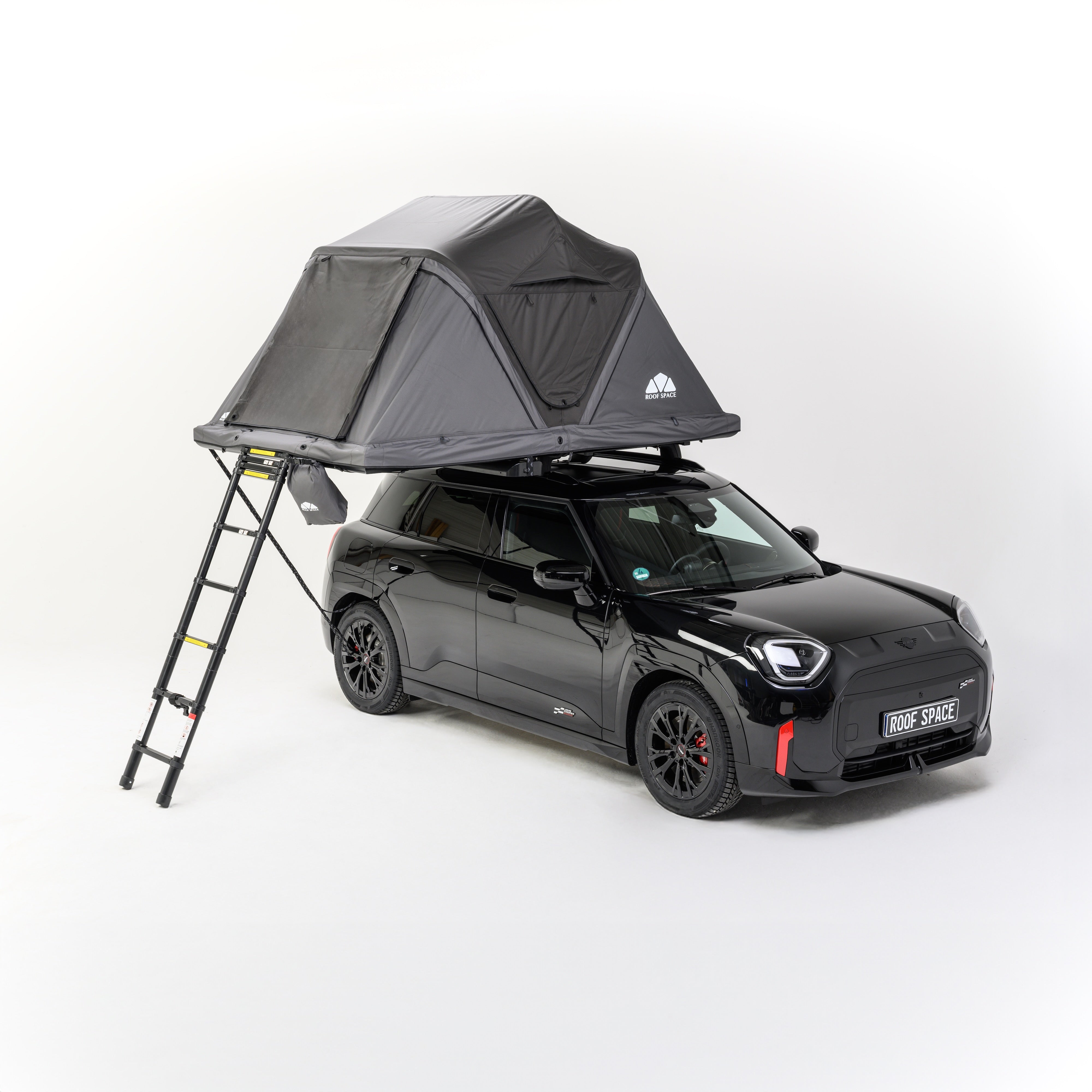
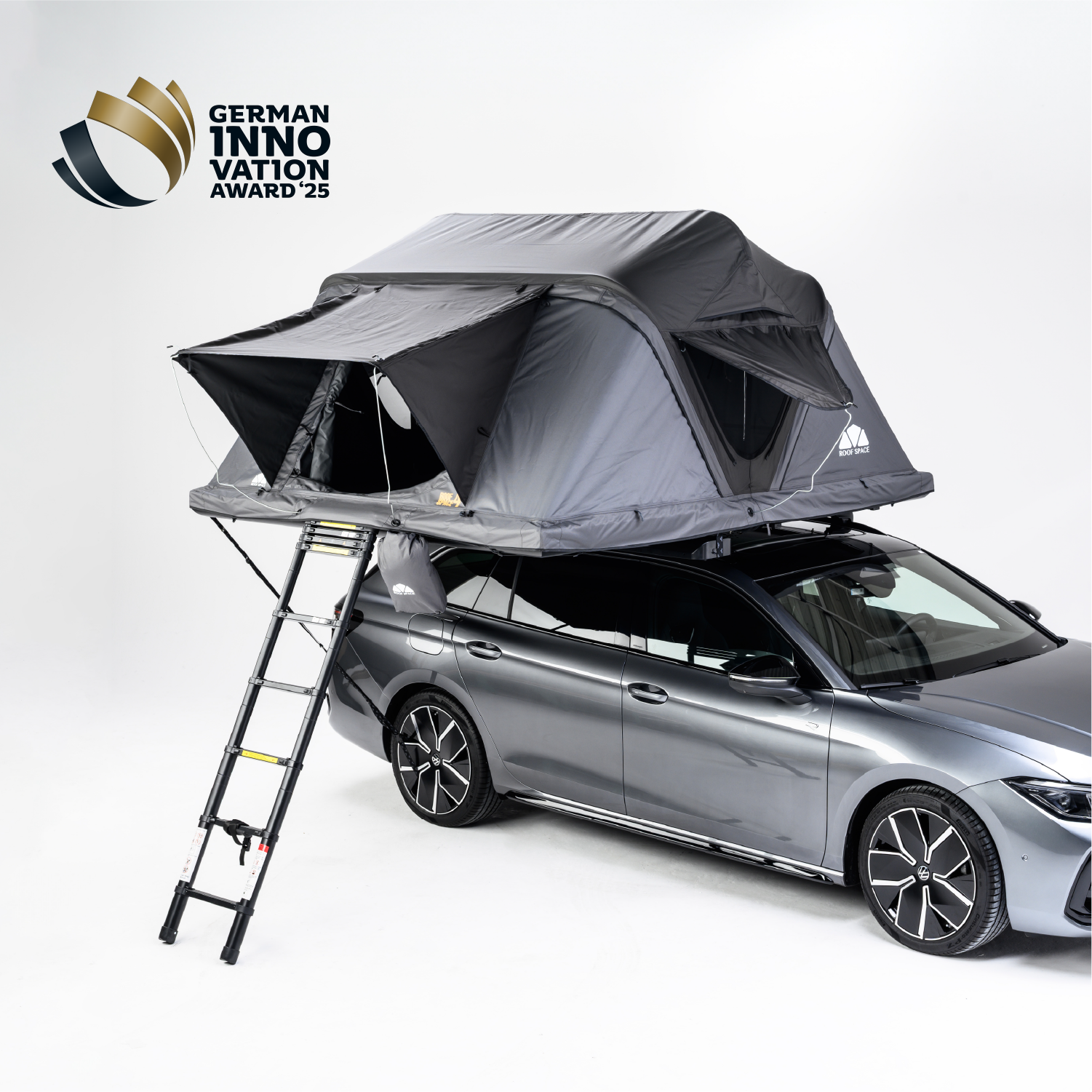
A rooftop tent is a tent that mounts to the roof bars of your vehicle and opens into an elevated sleeping platform, so you camp above the ground instead of on it. Roof Space tents are a fusion design: a hard shell for aerodynamics, weather protection and security on the road, combined with the fold-out sleeping area of a soft-shell tent. You unclip the latches, the shell lifts, and the tent unfolds over the side of the vehicle.
Why choose a rooftop tent over a ground tent?
You get a flat, dry, level bed anywhere you can park, in about two minutes. There is no clearing rocks or sticks, no wet groundsheet, no packing a soaked tent in the morning, and you are up off the dirt, water and wildlife. The mattress lives inside the tent permanently, so bedding stays made up between trips — most owners find that alone changes how often they go away.
Is a rooftop tent comfortable to actually sleep in?
Yes — the sleeping surface is a full mattress on a solid base, not an inflatable pad on uneven ground. Because the platform is rigid and level, you are not rolling into a dip at 2am. The elevation also keeps you out of ground damp and cold air pooling, which makes a noticeable difference on cool nights in the high country.
How long does it take to set up and pack down?
Setup is under two minutes and can be done solo — release the latches, lift, and the tent unfolds. Pack-down takes a little longer because you tuck the canvas in as the shell closes, but most owners are back on the road inside five minutes. There are no poles to thread and no pegs unless you are also pitching an annex.
Can I use a rooftop tent in all four seasons?
Yes. Roof Space tents are built for year-round use, and in Australian and New Zealand conditions the main considerations are heat and wind in summer and condensation in winter. For genuinely cold trips — alpine NSW and Victoria, or the South Island in winter — the Thermal Inner Tent adds an insulating layer that also cuts condensation significantly.
Can I leave the tent on my car all year?
Yes, many owners do. The closed hard shell is weatherproof and locks, so the tent can stay mounted between trips. The trade-offs are fuel consumption, extra height in car parks and garages, and the fact that your vehicle is permanently at its raised height. If you only camp a few times a year, taking it off between trips is straightforward with two people.
How much does a rooftop tent affect fuel use?
Expect a noticeable increase, usually in the range of one to three litres per hundred kilometres depending on the vehicle, speed and how boxy the car already is. A hard-shell tent like the Roof Space is far better here than a soft-shell in a travel cover, because the closed shell is a smooth aerodynamic form rather than a canvas brick.
Is it safe to sleep up there in wind?
Yes, within sensible limits. The tent is anchored to the roof bars, which are anchored to the vehicle, so the whole assembly moves as one. In strong wind you will feel movement and hear canvas, the same as any tent. Park with the vehicle nose or tail into the wind rather than broadside, and close any annex awning rather than leaving it flying.
Roof Space 2 (RS2)
Our two-person fusion rooftop tent.
Who is the Roof Space 2 for?
The RS2 suits couples, solo travellers and anyone whose vehicle has a lower roof load rating. It weighs 67 kg and needs a minimum dynamic roof load of 75 kg, which brings a very wide range of wagons, utes, vans and 4WDs into play — including many vehicles that cannot legally carry a larger tent.
How many people fit in the RS2?
The RS2 sleeps two adults comfortably. Families with a small child often manage three at a squeeze, but if you are regularly sleeping three or more, the RS4 with its 205 x 200 cm sleeping area is the better answer.
What is Panoramic Mode?
Panoramic Mode turns the RS2 into an open rooftop terrace. Instead of the full canvas configuration, you open the tent out so the sleeping platform becomes a shaded, elevated deck with an uninterrupted view — good for a coastal lookout, a long lunch stop, or a fine-weather night looking at the sky.
What roof load do I need for the RS2?
Your vehicle needs a minimum dynamic roof load rating of 75 kg. Dynamic rating is the weight your roof can carry while driving; it is set by the vehicle manufacturer and listed in your owner's manual. The RS2 weighs 67 kg, which leaves headroom for the bars themselves.
Does the RS2 come with a mattress?
Yes. A premium mattress is included and stays inside the tent when it is folded down, along with your bedding. You do not need to buy a separate sleeping pad or remove the mattress between trips.
Can I fit an annex to the RS2?
Yes. The Light Base annex attaches under the RS2 to create an enclosed room at ground level for changing, storage or an extra bed. The Light Awning adds shade off the side of the tent, and the RS2 + Light Base bundle packages the two together.
Roof Space 4 (RS4)
Our extra-wide fusion tent for families.
Who is the Roof Space 4 for?
The RS4 is for families and anyone who wants maximum sleeping width without giving up hard-shell convenience. It combines the two-minute setup and aerodynamics of a hard shell with the extra-wide sleeping area of a fold-out tent — a combination that did not exist before this model.
How big is the RS4 sleeping area?
205 x 200 cm — wider than a domestic king bed. That is genuinely enough room for two adults and two children, or four adults who know each other well.
What roof load do I need for the RS4?
Your vehicle needs a minimum dynamic roof load rating of 100 kg. The RS4 weighs 90 kg, so you also need to account for the weight of your roof bars or platform. This rules out many small wagons and some utes with light-duty tub racks, so check your owner's manual before ordering.
RS2 or RS4 — how do I choose?
Start with your vehicle, not your preference. If your dynamic roof load rating is under 100 kg, the RS2 is your answer. If you have the rating and you regularly camp as a family or want the extra width, take the RS4. Both set up in under two minutes and both take the same annex and accessory range.
Is the RS4 harder to set up than the RS2?
No. Both are a single-fold design that one person can open in under two minutes. The RS4 canvas is larger, so pack-down takes marginally longer as you tuck the fabric in, but the process is identical.
Does the RS4 work on a ute canopy or tray?
Usually yes, provided the canopy or tray rack is rated for the load. This is the key point people miss: the limit is set by the rack and canopy manufacturer, not the vehicle roof, and a canopy rated for a static camping load may have a much lower dynamic rating. Get the rating in writing from the canopy maker before ordering.
Fitting it to your vehicle
Mounting, tools and compatibility.
Will a Roof Space tent fit my car?
If your vehicle can take two crossbars spaced appropriately and meets the dynamic roof load requirement — 75 kg for the RS2, 100 kg for the RS4 — it will almost certainly fit. The tent mounts to standard two-bar roof racks or a flat platform. We have vehicle-specific guides for Ford, Jeep, Land Rover, Mitsubishi, Porsche, Toyota, Volkswagen and Volvo, and you can always send us your make, model and year and we will check.
Can I fit the tent myself?
Yes, with two people and basic tools. The tent slides onto the crossbars on rails and clamps from underneath. The lifting is the hard part — the RS2 is 67 kg and the RS4 is 90 kg — so recruit a second (ideally third) person, or ask your nearest dealer to fit it for you.
How long does the first installation take?
Allow around 30 to 45 minutes for a first fit, including squaring the tent up on the bars and torquing the clamps. Once the position is set, removing and refitting the tent later takes about 10 minutes plus the lifting.
What roof racks do I need?
Any quality two-bar system rated for the load — Rhino-Rack, Yakima, Thule, Prorack and similar all work, as do flat platforms and ute canopy racks. What matters is the bar's rated dynamic capacity and that the bars are far enough apart to support the tent base properly. Aero or square bars are both fine.
How far apart should the crossbars be?
As a rule of thumb, spread the bars as widely as your roof allows within the manufacturer's limits — wider spacing spreads the load and reduces flex on rough roads. Check the fitting instructions supplied with the tent for the minimum and maximum spacing, and never mount the tent to a single bar.
Can I put the tent on a trailer or camper?
Yes, and it is a common setup — a tent on a purpose-built trailer rack frees the vehicle roof and lowers the climb. The same rules apply: the rack must be rated for the dynamic load, and the trailer must remain within its own load and towing limits.
Roof load, height and the law
What is legal in Australia and New Zealand.
What is the difference between dynamic and static roof load?
Dynamic load is what your roof can carry while the vehicle is moving; static load is what it can carry while parked. Static capacity is far higher — the roof is supported by the whole structure and there are no cornering or braking forces — which is why a 90 kg tent plus two adults sleeping in it is fine on a roof rated at 100 kg dynamic. Always size your tent against the dynamic figure.
Where do I find my vehicle's roof load rating?
Your owner's manual is the authority, usually under roof rack or roof load. If it is not there, the vehicle manufacturer's Australian or New Zealand customer line can confirm it. Do not rely on forum figures — ratings vary between model years and between wagon, ute and canopy variants of the same badge.
Does the weight of the roof rack count?
Yes. The dynamic rating covers everything you add to the roof: bars, mounting feet, platform, the tent and anything strapped on top. Subtract the weight of your rack system from the rating before comparing it against tent weight.
Is there a legal height limit with a tent fitted?
Yes. In Australia the general limit for a light vehicle is 4.3 m overall height, and in New Zealand it is 4.25 m — neither is remotely at risk with a rooftop tent on a normal vehicle. The practical limits are car parks, drive-throughs, service station canopies and low branches, so measure your loaded height and write it on a sticker on the dash.
Do I need to tell my insurer?
Check with your insurer. A rooftop tent is an accessory permanently fitted to the vehicle, and most comprehensive policies expect modifications and accessories to be declared so the tent itself is covered against theft or damage. It is a short call and worth making before your first trip.
Can I sleep in the tent anywhere?
No — where you can sleep is set by local rules, not by the tent. Australia and New Zealand both have areas where roadside or freedom camping is restricted or banned, and councils enforce it. Use designated campgrounds, national park sites, and in New Zealand the freedom camping rules that apply to non-self-contained vehicles, which is what a rooftop tent counts as.
Setup, sleeping and living in it
Day-to-day use.
Can one person set the tent up?
Yes. Both models are designed for solo setup in under two minutes — release the latches, lift the shell and the tent unfolds. Pack-down is also a one-person job once you have the knack of tucking the canvas as the shell comes down.
Do I need to remove bedding before closing the tent?
No. Pillows, sleeping bags and doonas stay inside when the tent folds down, which is one of the biggest practical advantages of the format. Keep bulky items away from the fold line so the shell closes cleanly.
How do I get up and down?
A telescopic ladder is included and hooks onto the tent entrance. Set it at a comfortable angle rather than vertical, and make sure the feet are on firm, level ground — a small board under the ladder feet on soft sand or grass makes a real difference.
What about condensation?
Condensation comes from breath and body moisture meeting cool fabric, and every tent gets it. Keep at least two vents or windows partly open even in cold weather, avoid drying wet gear inside, and if you camp in cold conditions often, fit the Thermal Inner Tent — it keeps the inner surface warmer so moisture does not form on it.
Can I leave the tent open unattended while I drive off?
No. The tent must be closed and latched before the vehicle moves, and an open tent left at a campsite is both a theft target and vulnerable to a wind change. If you want to keep a site while you explore, an annex or a ground tent is the answer.
Is it noisy in rain?
You will hear rain, as in any tent, but the hard shell over your head makes it a duller sound than a soft-shell drumming directly above you. Most people find it good sleeping weather rather than a problem.
Australian conditions
Heat, dust, rain and salt.
How does the tent handle Australian heat?
Ventilation is what makes summer comfortable — open opposing windows to get airflow across the sleeping area rather than one window on its own, and park so the tent opens away from the afternoon sun. The Light Awning adds shade over the entry, which drops the internal temperature noticeably in the late afternoon.
Is it suitable for corrugated outback roads?
Yes, provided your rack system is up to it and everything is properly torqued. Corrugations are hard on fasteners, so check the mounting clamps and any accessory bolts at the end of each corrugated section — a habit worth building on the Oodnadatta or the Gibb River Road.
What about red dust getting inside?
The closed shell seals well, which is a major advantage over soft-shell tents on dusty routes. Fine dust can still find its way into the canvas folds, so shake the canvas out before closing and give the tent a proper air and vacuum after a dusty trip.
Can I use it near the coast?
Yes, with sensible maintenance. Salt air accelerates corrosion on any hardware, so rinse the shell, hinges, latches and mounting clamps with fresh water after beach camping and dry the canvas before folding it away.
Will it handle tropical rain up north?
The tent is built for sustained rain and the shell sheds water off the sleeping area. In the tropics the real enemy is packing away damp — mould grows fast in humidity, so if you have to close the tent wet, open and dry it fully within a day or two.
Is it OK in a bushfire risk area?
Treat it like any camping setup: check local fire danger ratings and total fire bans before you travel, camp where the local authority allows it, and have an exit plan that does not depend on packing the tent. Being on the roof means you cannot leave in a hurry without closing up first — that is a real consideration on a high fire danger day.
New Zealand
Buying and camping across the Tasman.
Do you ship to New Zealand?
Yes. Roof Space tents and accessories ship to New Zealand, and we have a dedicated New Zealand page with current availability, dealers and delivery information. If you want a delivered price to your address, email us with your postcode and the model you are after.
Is there a Roof Space dealer in New Zealand?
Our dealer network is listed on the Find a Dealer page, which covers both Australia and New Zealand. If there is no dealer near you, we ship direct and support you by phone and email for fitting questions.
How do New Zealand duties and GST work?
Goods entering New Zealand can attract GST and duty depending on value and how the order is placed. We will confirm exactly what applies to your order before you commit — email us with the model and your delivery address and we will spell out the landed cost.
Does a rooftop tent affect my Warrant of Fitness?
The tent itself is not a WoF item, but anything fitted to the vehicle must be securely mounted and must not obscure lights or vision. Use a rack system rated for the load, keep the mounting hardware torqued, and you will not have an issue.
Can I freedom camp with a rooftop tent in New Zealand?
Only where non-self-contained camping is permitted. A rooftop tent does not make a vehicle self-contained under New Zealand rules, so many freedom camping areas that allow certified self-contained vehicles are not open to you. Check the local council rules and the Department of Conservation campsite listings before you plan a night.
Is the tent suitable for South Island winters?
Yes, with the right setup. Add the Thermal Inner Tent for insulation and condensation control, use a sleeping bag rated well below the expected overnight low, and keep ventilation open despite the cold — sealing the tent up is what makes you wake to wet canvas.
Annexes and accessories
Extending the tent.
What is the difference between the Light Base and the Family Base?
Both are annexes that hang below the tent to create a room at ground level. The Light Base is the compact, lighter option for changing, storage and shelter. The Family Base is the larger version, giving enough enclosed floor space to use as a second sleeping room or a proper living area on longer stays.
What does the Light Awning do?
The Light Awning extends off the side of the tent to give shade and rain cover over the entry and the area beside the vehicle. It is the single most-used accessory in Australian conditions, because it turns the space beside the car into usable living area in the middle of the day.
What is the Thermal Inner Tent for?
It is an insulating inner layer that clips inside the tent. It keeps warmth in on cold nights and, just as importantly, keeps the inner surface warm enough that condensation forms much less readily. Worth it for alpine, desert-winter and South Island trips.
What is the Panoramic Screen?
The Panoramic Screen is the mesh panel system that lets you open the tent up to the view while keeping insects out — the practical half of Panoramic Mode on a warm evening.
Can I add accessories later, or should I buy them upfront?
You can add any accessory at any time; nothing requires factory fitting. That said, the bundles pair a tent with the Light Base at a better combined price, so if you already know you want the annex it is cheaper to take it with the tent.
How do I stop someone stealing the tent?
Anti-theft locking nuts replace the standard mounting hardware so the tent cannot be unbolted from the bars without the matching tool, and the closed shell latches down over your bedding and gear. For long unattended stops, park where the vehicle is visible and consider a rack-level cable through the mounting rails as well.
Ordering, delivery and payment
Buying from us.
How do I order?
Order directly through this website, or contact us and we will take you through it. If you would rather see a tent first, check the Find a Dealer page for your nearest stockist, or the Events page for shows we are attending.
Can I see a tent before I buy?
Yes. Our dealers hold demonstration tents, and we take the full range to camping and 4WD shows — the Events page lists what is coming up. If you are close to Erina on the NSW Central Coast, get in touch and we will sort out a look in person.
How is the tent delivered?
Rooftop tents ship on a pallet by freight, not by regular parcel courier, because of their size and weight. That means a delivery window rather than a letterbox drop, and you will need someone available to receive it and help move it. Accessories ship by standard courier.
Do I need help to receive the delivery?
Yes — plan for two or three people. The RS2 is 67 kg and the RS4 is 90 kg in the carton, and the driver is not required to help move it beyond the tailgate. Having a second pair of hands and a clear path to where the tent will live saves a lot of grief.
What payment methods do you accept?
All the standard options at checkout, including major cards and the wallet and buy-now-pay-later options shown on the payment step. If you need an invoice for a business purchase, email us before ordering and we will arrange it.
Can I change or cancel my order?
Contact us as soon as possible. If the order has not yet been dispatched to freight we can usually amend or cancel it. Once a pallet is in the freight network it has to run its course, and change-of-mind then falls under our returns policy.
Warranty, spare parts and support
After you buy.
What warranty applies?
Roof Space products are covered by a manufacturer's warranty, and separately by the guarantees in the Australian Consumer Law, which cannot be excluded — that includes acceptable quality, fitness for purpose and repair or replacement where a product fails. Full terms are on our Refund and Warranty policy page.
What is not covered?
Normal wear, accident damage, and damage from misuse are not covered — the most common examples being driving with the tent open or unlatched, exceeding the roof load rating, and mould from storing the canvas wet. Look after those three and you will not have a problem.
Can I get spare parts?
Yes. Wear items are available separately — replacement tension straps and spring steel rods are stocked, and we can source other components. Email us with your model and a photo of the part and we will identify it.
What if something arrives damaged?
Photograph the carton and the damage before you unpack any further, and contact us the same day. Freight damage claims depend on evidence at the point of delivery, so those photos matter — with them, we resolve it quickly.
Where do I find the fitting and user instructions?
The Instructions page has the current fitting and operating documents for each model, and the Rooftop Tent Guide covers the wider how-to material. Dealers can also access technical documents through Dealer Downloads.
How do I contact support?
Email sales@roofspace.com.au or call 0452 282 200 — we are on the NSW Central Coast at 16/94 The Entrance Road, Erina NSW 2250. Include your model and order number and, for anything mechanical, a photo. We answer our own email, so you are not going through a call centre.
Care, storage and cleaning
Making it last.
How do I clean the canvas?
Brush off dirt when dry, then sponge with clean water and a mild, non-detergent soap. Avoid household detergents, solvents and pressure washers — they strip the water-repellent finish and can damage stitching. Rinse thoroughly and dry fully before folding away.
How do I clean the hard shell?
Wash it like the vehicle — car wash soap, soft mitt, rinse and dry. Skip abrasive pads and harsh chemicals, and give the latches and hinges a fresh-water rinse after coastal or dusty trips.
What if I have to pack it away wet?
Get it open and dried within 24 to 48 hours. Damp canvas grows mould quickly, particularly in a humid Australian summer, and mould damage is not a warranty matter. If you cannot open the tent on the road, opening it at home under a carport is enough.
Can I remove and store the tent between trips?
Yes. Lift it off with two or three people onto a padded surface or a purpose-made wall hoist, store it closed and dry, and keep it out of direct sun. Do not store it standing on its edge unsupported for long periods.
How should I look after the mattress?
Air it whenever the tent is open at home, use a fitted sheet to keep the surface clean, and let it dry fully if it ever gets damp. Because the mattress lives inside the closed tent, trapped moisture is the main thing to guard against.
Does the canvas need re-proofing?
Eventually, yes — the factory water-repellent finish is a consumable, and how long it lasts depends on UV exposure more than anything else. If water stops beading and starts soaking in, re-proof with a product made for tent canvas rather than a general fabric spray.
Can't find it?
Ask us directly — we answer our own email, from Erina, NSW.
This feature requires Vue.js to be available in the theme.